Both being members of the weasel family in North America, American martens and American mink are similar in several ways. Both species have counterparts in Eurasia. They are about the same size, up to three pounds in the larger males, and about two feet long. Both species are slender-bodied, and have long, luxuriant fur, bushy tails and short legs for slipping into cavities after prey. Both are quick in motion and fast-running to capture prey. Both these species are aggressive, incessant, opportunistic predators that eat insects, mice, squirrels, small birds and so on. And each kind, in turn, is preyed on by red foxes, coyotes, bobcats, great horned owls, golden eagles and other predators. Each type of weasel must raise up to five young a year to make up for losses.
Both these weasel species inhabit forests and smaller woodlands, but martens live in trees and mink dwell along waterways, thus reducing competition for food with each other. Becoming adapted to different habitats to lessen rivalry for food and shelter is what causes different species of life, including the various types of weasels.
Also called pine martens, American martens live in the bigger trees of mature coniferous and mixed forests of Canada and Alaska. Beautiful creatures, their fur color is yellow-buff to tawny-brown with lighter-hued hair on their heads. Tail and leg hair is darker than on their bodies. And their throats are straw-colored to orange. Their feet are adapted for climbing in trees: They even move down a tree head-first, like squirrels.
Forest destruction and over-trapping have reduced marten numbers in North America. And although they are now protected from trapping here, logging still destroys their habitats.
Living throughout most of North America, the adaptable American mink are semi-aquatic weasels that live along waterways and impoundments, in woods for the most part. Mink are more stream-lined in body shape than martens are so they can swiftly slip through water after prey. Some females of this weasel species raise young in abandoned muskrat burrows in stream banks, after they killed and ate the muskrats. Mink also eat fish, frogs, water snakes, crayfish and other water creatures.
I have seen several mink, both male and female, along waterways and ponds in southeastern Pennsylvania. They are common here. Males are larger and darker than their sisters. I have even spotted a couple of their dens, such as a deserted wood chuck tunnel near a creek and a cavity among exposed tree roots that a female mink ran in to along a stream. I once saw a female mink carrying several mice and a gray squirrel she killed down that chuck hole in the hour I watched her and her underground nursery. And I saw a different female mink ferrying her five babies, one at a time, across the Conestoga River in Lancaster County.
Each of these weasel species has been trapped for their beautiful, valuable fur. Mink still are. And mink are even raised on mink ranches for their furry pelts, which takes the pressure off trapping their wild relatives.
Martens and mink are similar in appearance (very attractive) and actions, the former species in trees and the latter one around fresh water. Both these forest species are exciting and interesting to experience when spotted.
Sunday, July 6, 2014

Saturday, July 5, 2014
A Few Sphinx Moths
White-lined sphinx moths, hummingbird moths and two kinds of hornworm moths are fairly common in southeastern Pennsylvania. And they are attractive and interesting when seen in mid to late summer each year. They all visit flowers to sip sugary nectar like butterflies do during the day: The white-lines and hornworms at night, but the hummingbird moths during the day. The caterpillars of each species have a "horn" near the rear of their bodies, which demonstrates their being related to each other.
Sphinx moths as a group are stout-bodied with stiff, powerful wings that are swept back when those insects are at rest. They each have a long proboscis to sip nectar, which is curled under the head when not being used.
White-lined sphinx moths are mostly light-brown with white lines on their two front wings and abdomens. Their smaller back wings are pink, bordered with dark-brown. They inhabit open areas such as meadows and gardens where flowers are abundant from southern Canada to Latin America and from coast to coast.
The caterpillars of white-lined sphinx are green for camouflage, with yellow heads and two side rows of pale spots bordered with black. These larvae eat the foliage of chickweed, purslane, apple, plum, turnip, tomato and melon. And they overwinter as pupae in the ground.
Hummingbird moths are daytime moths and are unmistakable when seen among blossoms with bees, butterflies and other kinds of insects there to get nectar. Hummingbird moths resemble large bees, but hover like hummingbirds before blooms while they probe with their proboscis for nectar, then dart away to another blossom.
Hummingbird moths inhabit forest edges, meadows and flower gardens in the eastern half of the United States. There are two generations of them every year.
The caterpillars of hummingbird moths are yellowish-green with darker green lines and reddish-brown spots on their abdomens. They consume the leaves of honeysuckles.
The closely-related tobacco and tomato hornworm moths are about four inches long and have cryptic, grayish-brown coloring for camouflage during the day when they are at rest. They also have a row of five yellow dots on each side of their abdomens. They live, for the most part, in farmland in the eastern half of the United States.
The four-inch larvae of these two kinds of hornworm moths are seen more than the adults are, particularly in tobacco fields. Commonly called tobacco worms, those caterpillars are green with a black horn at the rear and a V-shaped, white mark on the side of each segment. These caterpillars ingest plants in the nightshade family, including tomato, tobacco and potato foliage, mostly at night. They pupate in unlined cells in the ground where they fed on plants.
Sphinx moths are pretty and interesting insects. But one must search for them at night, except for hummingbird moths.
Sphinx moths as a group are stout-bodied with stiff, powerful wings that are swept back when those insects are at rest. They each have a long proboscis to sip nectar, which is curled under the head when not being used.
White-lined sphinx moths are mostly light-brown with white lines on their two front wings and abdomens. Their smaller back wings are pink, bordered with dark-brown. They inhabit open areas such as meadows and gardens where flowers are abundant from southern Canada to Latin America and from coast to coast.
The caterpillars of white-lined sphinx are green for camouflage, with yellow heads and two side rows of pale spots bordered with black. These larvae eat the foliage of chickweed, purslane, apple, plum, turnip, tomato and melon. And they overwinter as pupae in the ground.
Hummingbird moths are daytime moths and are unmistakable when seen among blossoms with bees, butterflies and other kinds of insects there to get nectar. Hummingbird moths resemble large bees, but hover like hummingbirds before blooms while they probe with their proboscis for nectar, then dart away to another blossom.
Hummingbird moths inhabit forest edges, meadows and flower gardens in the eastern half of the United States. There are two generations of them every year.
The caterpillars of hummingbird moths are yellowish-green with darker green lines and reddish-brown spots on their abdomens. They consume the leaves of honeysuckles.
The closely-related tobacco and tomato hornworm moths are about four inches long and have cryptic, grayish-brown coloring for camouflage during the day when they are at rest. They also have a row of five yellow dots on each side of their abdomens. They live, for the most part, in farmland in the eastern half of the United States.
The four-inch larvae of these two kinds of hornworm moths are seen more than the adults are, particularly in tobacco fields. Commonly called tobacco worms, those caterpillars are green with a black horn at the rear and a V-shaped, white mark on the side of each segment. These caterpillars ingest plants in the nightshade family, including tomato, tobacco and potato foliage, mostly at night. They pupate in unlined cells in the ground where they fed on plants.
Sphinx moths are pretty and interesting insects. But one must search for them at night, except for hummingbird moths.
Leafcutter Bees
One summer day I noticed several semi-circular, three-quarter inch holes on the edges of a few leaves of the red bud tree in our back yard. I knew pieces of the leaves were cut off and carried away by leafcutter bees, but I didn't know details why the bees cut them so I did a little research.
Leafcutter bees are native to much of the United States and important pollinators of flowers. They are solitary nesters, not aggressive and have mild stings. They are about the size of honey bees, but dark with white or silver hairs. Females' abdomens have dense brushes of hairs that carry pollen from the blossoms to the bees' nests.
Each female leafcutter nests in soft, rotted wood or in the stems of large, pithy plants such as roses, which we have in our yard. The pithy insides of some of our rose stems are exposed to the outside because of pruning, giving female leafcutters easy access to the inside of the stems.
The nesting tunnel of each female leafcutter bee may be several inches deep. She cuts out each semi-circular section of leaf with her mouth parts to make rolled-up nest cells with those leaf parts in the burrow of wood or pith. She places a mixed ball of nectar and pollen in each leafy cell, lays an egg on it and seals each cell with a round piece of leaf. Each cell resembles a tiny cigar butt and those cells are in a closely-packed series of a dozen or more in the tunnel, though a female leafcutter bee can lay up to 40 eggs. The larva in each little chamber eats its provision of nectar and pollen until the food is gone, pupates in its cell and emerges the next spring as an adult male or female bee.
Leafcutter bee species live all over the world. There are about 140 kinds in North America. Most of us don't see leafcutter bees, but we can more readily spot their interesting rounded or semi-circular works on thin, deciduous leaves of several kinds of trees and shrubbery, including on our lawns.
Leafcutter bees are native to much of the United States and important pollinators of flowers. They are solitary nesters, not aggressive and have mild stings. They are about the size of honey bees, but dark with white or silver hairs. Females' abdomens have dense brushes of hairs that carry pollen from the blossoms to the bees' nests.
Each female leafcutter nests in soft, rotted wood or in the stems of large, pithy plants such as roses, which we have in our yard. The pithy insides of some of our rose stems are exposed to the outside because of pruning, giving female leafcutters easy access to the inside of the stems.
The nesting tunnel of each female leafcutter bee may be several inches deep. She cuts out each semi-circular section of leaf with her mouth parts to make rolled-up nest cells with those leaf parts in the burrow of wood or pith. She places a mixed ball of nectar and pollen in each leafy cell, lays an egg on it and seals each cell with a round piece of leaf. Each cell resembles a tiny cigar butt and those cells are in a closely-packed series of a dozen or more in the tunnel, though a female leafcutter bee can lay up to 40 eggs. The larva in each little chamber eats its provision of nectar and pollen until the food is gone, pupates in its cell and emerges the next spring as an adult male or female bee.
Leafcutter bee species live all over the world. There are about 140 kinds in North America. Most of us don't see leafcutter bees, but we can more readily spot their interesting rounded or semi-circular works on thin, deciduous leaves of several kinds of trees and shrubbery, including on our lawns.
Thursday, July 3, 2014
Birds in Winter Conifers
I lived outside Rohrerstown in Lancaster County, Pennsylvania when I was a child and youth during the late 1940's and early 1950's. The area around our house was farmland, with a couple of 50 acre patches of deciduous woods. A two-acre stand of Norway spruces and white pines was planted along the edge of one of the woodlots.
I was about eleven or twelve years old when I first visited that patch of conifers in winter with snow on the tree limbs and the ground. The trees were about twelve feet tall and the whole coniferous patch smelled of that wonderful piney scent. As I walked among those fragrant evergreen trees in the cold, damp air, several small, gray birds with white outer tail feathers flitted ahead of me, while chipping rapidly and trilling, and disappearing in the shadows of the needled boughs where they were still vocal. With my interest peaked, I approached those birds hidden among coniferous branches. And, as before, they flew ahead of me, chirping all the while and vanishing again in coniferous shadows.
Those little birds were dark-eyed juncos, which are members of the seed-and-insect-eating sparrow family. Juncos are dark-gray above like a winter sky and white below like snow on the ground. They nest farther north and down the higher mountains of the Appalachians to the Smoky Mountains. They only winter in Lancaster County, where they inhabit patches of evergreens in suburban areas, and elsewhere, near patches of weeds. They eat the seeds of those plants in winter.
Another winter day, about the same period of time as the one written about above, but a little later, I was walking in that same patch of conifers. Again juncos fluttered ahead of me and disappeared into needled shadows, chipping and trilling all the while.
But this time I also heard the muffled thumping of wings against needled branches in the tops of the conifers, and showers of snow dropping to the ground. There were bigger birds in those trees; up to a dozen of them I estimated as they flew from one tree top to another. When I finally got good looks at a couple of them, I saw they were owls, with tall feather tufts on their heads, standing upright on needled limbs. I stood still, then backed away from them so not to disturb them any more.
Sometime later I was able to identify them as long-eared owls, so-named for those long feather tufts. Like the juncos, long-ears also breed farther north and only winter in this part of Pennsylvania. They hole up in dense stands of coniferous trees during the day here in winter and hunt for mice across neighboring fields at night. They are sometimes spotted roosting in evergreens by finding their compact, regurgitated pellets of mouse fur and bones on the ground beneath their roosts.
Stands of young or half-grown evergreens in winter can be interesting with birds such as the juncos and long-ears. One has only to get out and walk among those trees.
I was about eleven or twelve years old when I first visited that patch of conifers in winter with snow on the tree limbs and the ground. The trees were about twelve feet tall and the whole coniferous patch smelled of that wonderful piney scent. As I walked among those fragrant evergreen trees in the cold, damp air, several small, gray birds with white outer tail feathers flitted ahead of me, while chipping rapidly and trilling, and disappearing in the shadows of the needled boughs where they were still vocal. With my interest peaked, I approached those birds hidden among coniferous branches. And, as before, they flew ahead of me, chirping all the while and vanishing again in coniferous shadows.
Those little birds were dark-eyed juncos, which are members of the seed-and-insect-eating sparrow family. Juncos are dark-gray above like a winter sky and white below like snow on the ground. They nest farther north and down the higher mountains of the Appalachians to the Smoky Mountains. They only winter in Lancaster County, where they inhabit patches of evergreens in suburban areas, and elsewhere, near patches of weeds. They eat the seeds of those plants in winter.
Another winter day, about the same period of time as the one written about above, but a little later, I was walking in that same patch of conifers. Again juncos fluttered ahead of me and disappeared into needled shadows, chipping and trilling all the while.
But this time I also heard the muffled thumping of wings against needled branches in the tops of the conifers, and showers of snow dropping to the ground. There were bigger birds in those trees; up to a dozen of them I estimated as they flew from one tree top to another. When I finally got good looks at a couple of them, I saw they were owls, with tall feather tufts on their heads, standing upright on needled limbs. I stood still, then backed away from them so not to disturb them any more.
Sometime later I was able to identify them as long-eared owls, so-named for those long feather tufts. Like the juncos, long-ears also breed farther north and only winter in this part of Pennsylvania. They hole up in dense stands of coniferous trees during the day here in winter and hunt for mice across neighboring fields at night. They are sometimes spotted roosting in evergreens by finding their compact, regurgitated pellets of mouse fur and bones on the ground beneath their roosts.
Stands of young or half-grown evergreens in winter can be interesting with birds such as the juncos and long-ears. One has only to get out and walk among those trees.
Beauties of Norway Spruces
All species of coniferous trees are handsome, including the majestic Norway spruces which are native to Europe, but planted abundantly on lawns in North America, including here in southeastern Pennsylvania. There they add much beauty, in themselves and the animals that live among them, through the year.
Norway spruces grow tall and stately with dark-green needles on twigs that hang from the main limbs. Those long branches sweep out, down and up again at the tips, taking the shape of bows.
There are a few beauties on these spruces in May. New, light-green needles grow on the tips of the twigs at that time, and contrast beautifully with the deep-green, older needles. At this time, too, red, inch-long female flowers, which are the shape of cones, droop from branches and contrast with the five-inch-long, beige cones from last year that hang from older limbs.
Older Norway spruces are magnificent in winter when they are most obvious because deciduous trees lose their leaves in autumn. The spruces offer a deep-green contrast to the gray of deciduous trees on lawns in winter. They are lovely on sunny days against a backdrop of blue skies and white and gray, cumulus clouds. And those spruces are also beautiful when snow piles on them and traces every limb and drooping twig.
Norway spruces are tough and resistant to wind, the weight of ice and snow and disease. While white pine branches break off in heavy wind or frozen precipitation, and eastern hemlock trees are succumbing to wooly adelgid aphids, Norway spruces do well on the lawns they were planted on.
This kind of spruce tree has beauties in the birds that seek cover among them. Red-tailed and Cooper's hawks, great horned owls, mourning doves, purple grackles and American crows are some bird species that nest in them. The hawks, owls and crows also shelter in them in winter, the owls during the day and the others at night. Dark-eyed juncos, pine siskins and long-eared owls, all of which breed farther north, shelter in groves of lawn spruces in winter as well, the owls by day and the little birds through the night. The needles and snow piled on them are like blankets, sheltering those birds from cold, winter winds.
Gray squirrels also build leafy homes in their needled boughs, where they might raise young. Those squirrels, and red squirrels, eastern chipmunks and other rodents eat many of the seeds in the spruce's cones.
A variety of small birds eat seeds from Norway spruce cones as well, particularly in winter. Some of those species are permanent resident Carolina chickadees and American goldfinches, and wintering black-capped chickadees, pine siskins, white-winged crossbills and red cross-bills. The siskins and crossbills are not in this part of Pennsylvania every winter, however. Crossbills have especially crossed beaks that they inherited to pry open the scales of the cones so their broad, sticky tongues can pull each seed out from under each scale.
Look at Norway spruces more closely anytime of year. They have many beauties and intrigues, in themselves and the animals that live among them.
Norway spruces grow tall and stately with dark-green needles on twigs that hang from the main limbs. Those long branches sweep out, down and up again at the tips, taking the shape of bows.
There are a few beauties on these spruces in May. New, light-green needles grow on the tips of the twigs at that time, and contrast beautifully with the deep-green, older needles. At this time, too, red, inch-long female flowers, which are the shape of cones, droop from branches and contrast with the five-inch-long, beige cones from last year that hang from older limbs.
Older Norway spruces are magnificent in winter when they are most obvious because deciduous trees lose their leaves in autumn. The spruces offer a deep-green contrast to the gray of deciduous trees on lawns in winter. They are lovely on sunny days against a backdrop of blue skies and white and gray, cumulus clouds. And those spruces are also beautiful when snow piles on them and traces every limb and drooping twig.
Norway spruces are tough and resistant to wind, the weight of ice and snow and disease. While white pine branches break off in heavy wind or frozen precipitation, and eastern hemlock trees are succumbing to wooly adelgid aphids, Norway spruces do well on the lawns they were planted on.
This kind of spruce tree has beauties in the birds that seek cover among them. Red-tailed and Cooper's hawks, great horned owls, mourning doves, purple grackles and American crows are some bird species that nest in them. The hawks, owls and crows also shelter in them in winter, the owls during the day and the others at night. Dark-eyed juncos, pine siskins and long-eared owls, all of which breed farther north, shelter in groves of lawn spruces in winter as well, the owls by day and the little birds through the night. The needles and snow piled on them are like blankets, sheltering those birds from cold, winter winds.
Gray squirrels also build leafy homes in their needled boughs, where they might raise young. Those squirrels, and red squirrels, eastern chipmunks and other rodents eat many of the seeds in the spruce's cones.
A variety of small birds eat seeds from Norway spruce cones as well, particularly in winter. Some of those species are permanent resident Carolina chickadees and American goldfinches, and wintering black-capped chickadees, pine siskins, white-winged crossbills and red cross-bills. The siskins and crossbills are not in this part of Pennsylvania every winter, however. Crossbills have especially crossed beaks that they inherited to pry open the scales of the cones so their broad, sticky tongues can pull each seed out from under each scale.
Look at Norway spruces more closely anytime of year. They have many beauties and intrigues, in themselves and the animals that live among them.
Tuesday, July 1, 2014
An Hour of Clover, Fireflies and Bats
At 8:00 this evening, July 1,2014, I sat in the back yard to be at one with nature. Right away I noticed that white clover flowers and male fireflies rising from the short grass and flashing their cold, abdominal lights were abundant on our lawn. The north-western sky was orange as the sun set and I thought about the sun not setting at all above the Arctic circle during this time of year. And although the temperature was in the mid 80's and the humidity was high, a steady breeze made being outdoors more tolerable.
As I watched the numerous fireflies flashing I saw a few chimney swifts careen across the sky after flying insects while the resident male catbird sang softly as if talking to himself. A few mourning doves dove into our tall spruce trees on whistling wings to stay the night while a mother robin continued to feed her babies in their nest. Other robins fluttered among the trees and called out from them.
Suddenly, a little brown bat flew out of a tree in our neighborhood and fluttered erratically across our lawn. Then another bat went over and another until I counted 5 maybe 6 little brown bats zipping across our back yard and away to spend much of the night catching flying insects. I was surprised, but glad, to see that many bats in our neighborhood.
I watched for an opossum or a striped skunk, both species of which have made appearances in our neighborhood in the past, but no such luck this evening. Nor did I see moths.
A few mosquitos found me about 9 o'clock and I thought it time to go in the house. But the sunset, breeze, fireflies and bats were entertaining and well worth the hour spent in the back yard.
As I watched the numerous fireflies flashing I saw a few chimney swifts careen across the sky after flying insects while the resident male catbird sang softly as if talking to himself. A few mourning doves dove into our tall spruce trees on whistling wings to stay the night while a mother robin continued to feed her babies in their nest. Other robins fluttered among the trees and called out from them.
Suddenly, a little brown bat flew out of a tree in our neighborhood and fluttered erratically across our lawn. Then another bat went over and another until I counted 5 maybe 6 little brown bats zipping across our back yard and away to spend much of the night catching flying insects. I was surprised, but glad, to see that many bats in our neighborhood.
I watched for an opossum or a striped skunk, both species of which have made appearances in our neighborhood in the past, but no such luck this evening. Nor did I see moths.
A few mosquitos found me about 9 o'clock and I thought it time to go in the house. But the sunset, breeze, fireflies and bats were entertaining and well worth the hour spent in the back yard.
The Adaptable Robins and Grackles
American robins and purple grackles are common birds on
lawns, meadows and fields through spring, summer and fall in the Mid-Atlantic States.
That is nothing profound, except robins and grackles probably inhabited
woodland clearings and wooded swamps respectively before European farmers
cleared the forests to create farms. These two bird species made great
adaptations to forage for invertebrates in those vast, human-made environments
where vegetation is close to the ground or absent. As the forests were cleared
and farmland created, both these species spread across the countryside and
greatly increased their numbers in what was, to them, an ever-expanding world.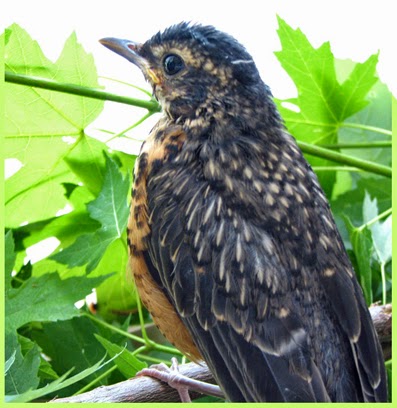
American Robins are members of the thrush family and young robins have spotted chests to prove it. Thrushes are forest birds that receded with the elimination of woodlands. But robins, having been pre-adapted to more open areas, expanded with the expansion of farmland and towns.
Robins, as a species, inhabit the middle Atlantic States the year around because they change their feeding habits. During warmer months they eat invertebrates, but locally wintering robins feast on berries in hedgerows and suburban areas, and shelter in coniferous trees for the night.
Robins that retreat south for the winter, return to this area early in March, bolstering the numbers of their relatives that stayed here through winter. At this time, flocks of scores of robins run and stop, run and stop on lawns, pastures and fields in their search for earthworms and other invertebrates. But if the soil freezes again, or snow covers it, they revert back to eating berries.
Robins nest in shrubs and young trees on suburban lawns as they did in woodland clearings. And because of that, robins are one of the first bird species to nest on the lawns of new suburbs as the planted bushes and trees grow.
By late summer and through autumn, young robins and their elders gather in flocks that roam through fields, pastures and lawns to consume berries and invertebrates. Youngsters are now full-sized with long tails, but are still spot-breasted like their thrush relatives.
Purple Grackles are members of the blackbird family, which includes red-winged and rusty blackbirds. Grackles have striking plumages, with their iridescent green and purple sheens and yellow irises.
Hordes of grackles pour into this area early in March. Their masses settle on fields, lawns and meadows to eat invertebrates, seeds and anything else edible they can handle. But soon their large flocks break into smaller groups that today nest in colonies in planted coniferous trees, which is another adaptation on their part. The adults glean invertebrates from nearby lawns, fields and pastures to feed their young in their nurseries in the conifers.
American robins and purple grackles adapted to human-made habitats, and made them more interesting to us. They were woodland birds that advantaged themselves to open environments, which has increased their populations as they spread with an expanding world. Adapting is a major key to success.
American Robins are members of the thrush family and young robins have spotted chests to prove it. Thrushes are forest birds that receded with the elimination of woodlands. But robins, having been pre-adapted to more open areas, expanded with the expansion of farmland and towns.
Robins, as a species, inhabit the middle Atlantic States the year around because they change their feeding habits. During warmer months they eat invertebrates, but locally wintering robins feast on berries in hedgerows and suburban areas, and shelter in coniferous trees for the night.
Robins that retreat south for the winter, return to this area early in March, bolstering the numbers of their relatives that stayed here through winter. At this time, flocks of scores of robins run and stop, run and stop on lawns, pastures and fields in their search for earthworms and other invertebrates. But if the soil freezes again, or snow covers it, they revert back to eating berries.
Robins nest in shrubs and young trees on suburban lawns as they did in woodland clearings. And because of that, robins are one of the first bird species to nest on the lawns of new suburbs as the planted bushes and trees grow.
By late summer and through autumn, young robins and their elders gather in flocks that roam through fields, pastures and lawns to consume berries and invertebrates. Youngsters are now full-sized with long tails, but are still spot-breasted like their thrush relatives.
Purple Grackles are members of the blackbird family, which includes red-winged and rusty blackbirds. Grackles have striking plumages, with their iridescent green and purple sheens and yellow irises.
Hordes of grackles pour into this area early in March. Their masses settle on fields, lawns and meadows to eat invertebrates, seeds and anything else edible they can handle. But soon their large flocks break into smaller groups that today nest in colonies in planted coniferous trees, which is another adaptation on their part. The adults glean invertebrates from nearby lawns, fields and pastures to feed their young in their nurseries in the conifers.
American robins and purple grackles adapted to human-made habitats, and made them more interesting to us. They were woodland birds that advantaged themselves to open environments, which has increased their populations as they spread with an expanding world. Adapting is a major key to success.
by Audrey ~ flickr
Subscribe to:
Posts (Atom)